How an open-source investigation by the Wall Street Journal unmasked the official narrative of the killing of Alex Pretti
U.S. Border Patrol head Greg Bovino justified the shooting of Alex Pretti, who was killed by federal agents at a protest in Minneapolis on Jan. 24, saying the 37-year-old ICU nurse was aiming to cause “maximum damage and massacre law enforcement.” Bovino and other officials claimed that Pretti “violently resisted” disarmament until the officers fired “defensive shots.” An analysis by The Wall Street Journal’s Visual Investigations team reviewed multiple videos of the events and concluded, “bystander footage appears to tell a different story.” Their account is a powerful example of how open-source investigative techniques can pierce the official story to present the truth on the ground. We spoke with Brenna T. Smith of the Journal for a behind-the-scenes look at how the project came together and the effects of repeatedly viewing the traumatic footage in the process.
The interview has been edited for length and clarity.
How did you all get called into this story?
It was a little bit of a whirlwind for me personally, because I was getting over the flu. I woke up to a call from my editor saying, “You’re on this assignment.” Because it happened on a Saturday, people were coming in when they were able. We just accumulated people as the day went on, as more people could sign on. The Visual Investigations team is me and my direct boss, Karly Domb Sadof, but we were joined by Emma Scott and Belle Cushing, who’ve been doing visual investigative work for years, as well as Jack Gillum. We regularly partner with people all around the newsroom to make [our work] happen. I think one of the biggest strengths of the Journal is how collaborative it is.
Did you have different roles on this project?
My main role was finding and verifying the footage, but also watching it for visual analysis — really spending time with it to understand what you can see and what you can say about it. After I did an initial sweep across social media trying to find original posters, authenticating with reverse image searching and geolocation to verify the footage, I set up a little bit of a war room monitoring things across different social media accounts. I pulled up as many Reddit threads as I could find about it, because often those will update when new footage comes in. I looked across Facebook, X and Telegram. In an incident like this, it actually is not that hard to find the footage — the footage hits you in the face. What is harder is trying to figure out when that footage was first posted and trying to find who originally posted it. Because the gold standard, especially when you’re trying to figure out timing for these things, is to be able to get in contact with the original poster, to be able to verify further things from there. In this case, that’s hard to do when everybody’s looking at the same story and everybody’s trying to find the same person. A lot of these people just saw this horrific, tragic death, right? They’re not going to be focused on responding to a reporter — and reasonably so. I put all of the information in a spreadsheet — over time we had this massive spreadsheet. And then I kind of switched gears to analyzing the footage and trying to figure out what we could say for a story.
While I was doing that, my colleague Jack Gillum was using his amazing data skills to parse the airwaves to find the police scanners to try to understand when EMTs got called in and so on so that we could narrow down timing more. He also was doing a really good job at paying attention to, like, what did [Homeland Security chief] Kristi Noem just say about this? What did Greg Bovino just say about this?
Were you comparing what you were seeing to what he was feeding you from the official account?
Yes, that was a key thing we wanted to do: to pay attention what the official narrative coming out from the government was and what the footage was showing. While that was happening, my colleague Belle Cushing who’s an amazing video journalist, was syncing all the footage together using Adobe Premiere so that we could watch from different angles the things that were happening at the same time. She and I co-partnered in doing a lot of the analysis.
A couple hours after I got on the story, footage from the so-called pink-coat lady [bystander Stella Carson] came in. She was the closest, filming the shooting as it happened. When her footage came out, it was like, “Oh, everybody needs to stop and really look at this” because it was the most complete footage and it also showed it from a direct angle where, for a couple hours, all you could really see was the footage from the other side of the street where it was mainly officers’ backs.
Something that I think the Journal does really well, but that also can add extra steps for us on breaking news events, is that we have a rigorous legal and standards process. So part of the challenge for us in these events is both wanting to be sure that we can get a story together as quickly as possible, not necessarily so that we can immediately publish it, but so that we can get it through the legal standards process. That’s especially true when we’re dealing with such sensitive imagery so that we can get that feedback of what aligns ethically for the paper and what aligns with what our lawyers think is best.
Our goal with the story and why Jack [Gillum]’s role was so critical, was to really understand what the government was saying at the moment about the shooting and then using their claims in pointing out different instances in the footage that either might have contradicted that or might have muddied the waters in some way or shown that it was more complicated. Our audience is more varied, perhaps, than other mainstream papers. We spend a lot of time thinking about framing and words and how to say things and what’s the fairest way to say things. Those are the same questions that we’re using to evaluate the footage. Is this a fair representation of what happened? Is this a fair clip? Should we have the clip be longer? Are we showing the totality of circumstances, or are we cherry picking?
There were a lot of places where you froze the frame. Was that a deliberate strategy and why did you do that?
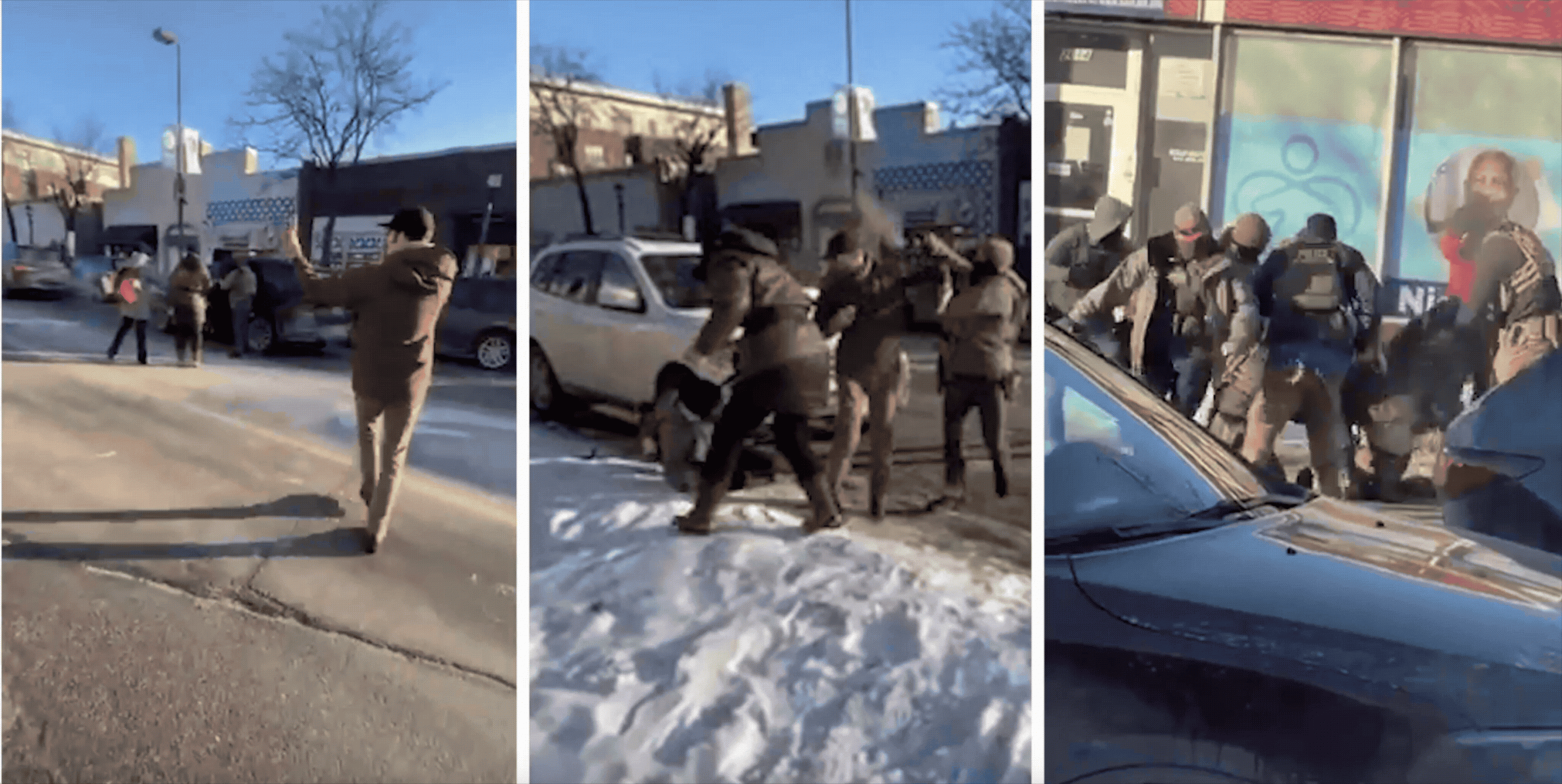
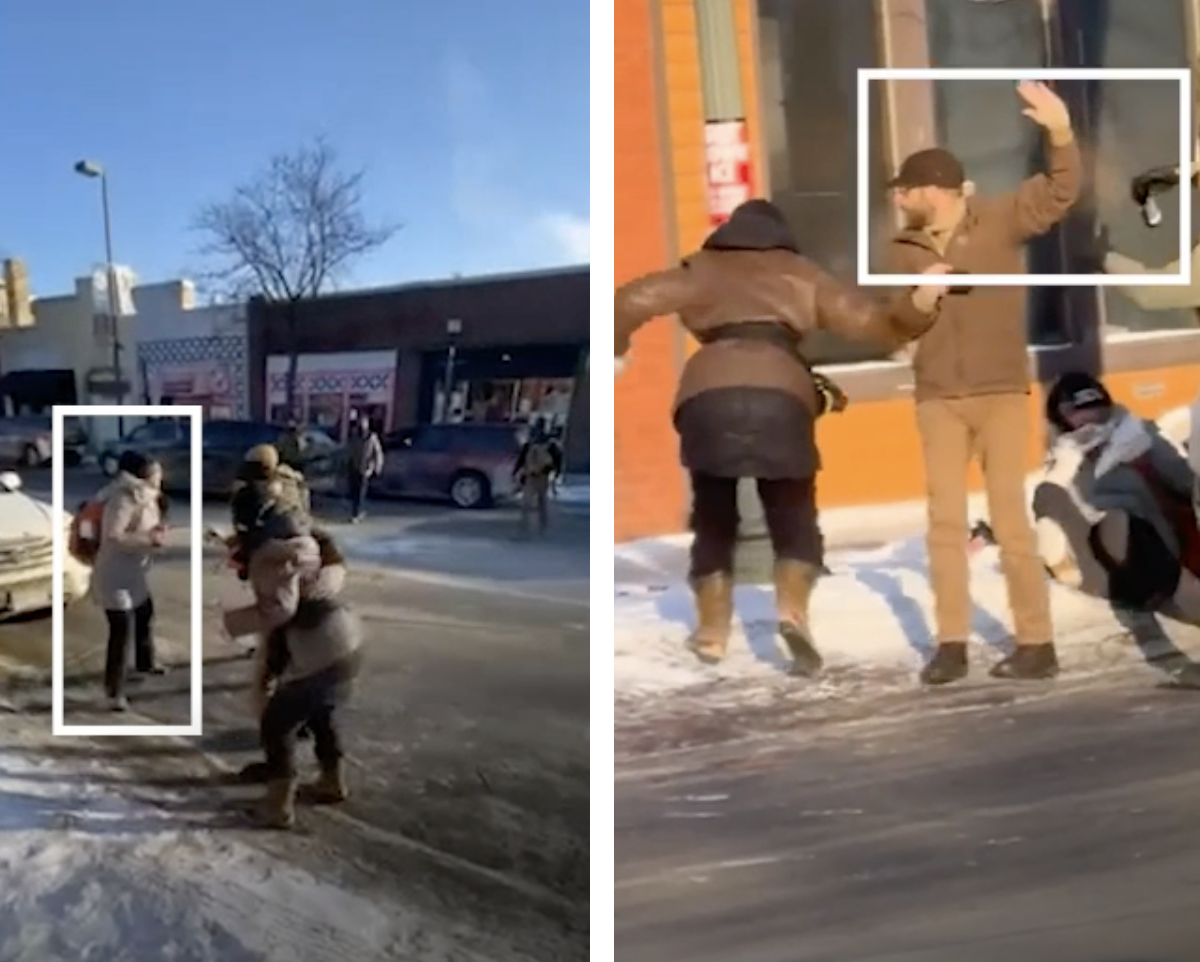
Yeah, I think that was a big thing for us. There were very specific things that Belle and I wanted the reader to see: we wanted them to see from the beginning of the interaction a little bit more of what Pretti was doing because a lot of the news cycle that day had been focused on the shooting itself. So we wanted to give a lot of context up until then, where he had a phone in his hand, when Pretti was with two other civilians, walking away from the federal agents that another agent came and pushed one of the people that he was with and Pretti got in between them. Showing that moment, I thought, was important because immediately after that happened, he and the group were pepper-sprayed by the federal agent. And even though those clips were half a second apart from each other, I wanted to break out those actions for readers to pay attention to; I wanted to make sure people were seeing those beats. And that was a lot of what we were trying to do with the call outs.
We then chose imagery from a different clip where you can more clearly see when the pepper spray was being deployed and what that looked like on Pretti. But also because he still had one hand filming and his other hand was open. Then we fast forward a little bit and basically show that when there was more of a scuffle that happened, initially it was two civilians on the ground and another person. And we show the moment where the agents kind of separate Pretti from the other person, because we thought it was important to show that he was essentially taken aside by at least five of the agents. Other moments that we thought were important to show included when one of the agents drew his gun, when another agent disarmed Pretti and took his gun, and then when shots started to be fired [by one agent] and another agent also brandished a firearm and shot, as well. I think that in my role, where the visuals are the key investigated findings to a story, I have to just spend a lot of time thinking about what is the most important thing to show here, what is the most important visual here? Then the words always come after.
When you’re working on a project like this, I imagine you’re looking at very disturbing footage over and over and experiencing the trauma second-hand. How do you deal with that personally and as a team?
We sometimes use the expression “vicarious trauma”: you’re not there, but you’re actually experiencing it over and over. It’s hard. That combined with the rush of a breaking news thing. I mean we were up late working on this. But my editor Carly is really good about talking with us and she made sure that we got some time off after this. For me, the hardest thing often is sleep after. It’s hard to go to sleep and not have these things pop up. So I always try, when I’m off deadline, to figure out ways to just get myself a lot of time to sleep.
Another thing I really try to do is talk about it. We’ll be honest and talk about when things bother us. But I also try to spend a lot of time afterwards not looking at my computer, not on screens. Reading helps me a lot and reading things that are in a totally different world and not related at all to work is really, really helpful. And, you know, the things that are so annoying, but do work, like working out and trying to move your body and just go on a walk. The thing that is hard to do on a breaking news thing that typically I can do when working on a long-term project is take breaks. I do think that I’m lucky enough that I work in an environment where if I can be like, “Hey guys, I need 20 minutes” or “This is a lot,” they obviously always allow that. Still, it’s a hard thing and I think we’re still figuring out in real time how to how to deal with vicarious trauma. There’s a lot of really great resources for journalists out there like the Global Center for Journalism & Trauma.
The day after our story ran, our editor started a group chat just to talk about this. And she titled it “Yucky videos,” and said, “Okay, guys, what do you need? You’re taking time off, right? What are you doing for when you’re coming back to work? Do you know the project? Is it similar imagery?” I think that a combination of a good boss and being able to R&R a little bit, you’re going to be okay.

- Satellite companies restrict journalists’ access to images from the Iran War - March 13, 2026
- Layoffs at The Washington Post gut an innovative newsroom - February 6, 2026
- How an open-source investigation by the Wall Street Journal unmasked the official narrative of the killing of Alex Pretti - January 29, 2026