Is the US Ready for the World Cup? Our Roads Might Not Be.
The world’s largest sporting event is coming to North America next summer. For the first time since 1994, the Fifa World Cup will be partially hosted in the United States, with games also being hosted in Canada and Mexico, for a massive 108 game tournament across 16 cities. Of those 108 games, the United States will host 78 (including all quarter-finals, semi-finals, and the final). It’s a chance for North America to show off its stadiums and soccer (futbol) spirit. But, beneath all the excitement and anticipation, experts are sounding alarms: the United States’ transportation systems may not be fully prepared for the number of fans the World Cup will bring, as some experts project anywhere from 5 to 6 million international fans.
As ESPN put it bluntly — the U.S. travel system is not ready for the World Cup or the 2028 Olympics, warning that everything from airports to transit systems could become gridlocked once the global phenomenon arrives this coming June.
A Tournament Spread Across Cities Built For Cars, Not Crowds
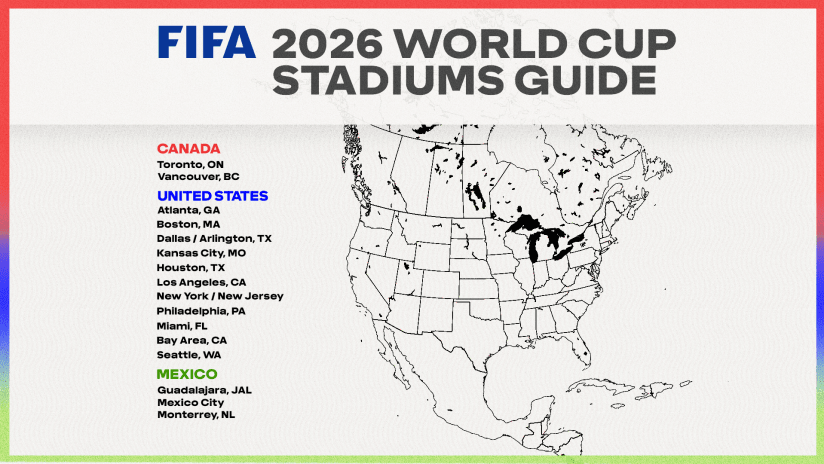
Unlike previous World Cups centered around a handful of more compact areas/cities, the 2026 World Cup sprawls across the continent, and in the U.S. Atlanta, Boston, Dallas, Houston, Kansas City, Los Angeles, Miami, East Rutherford, Philadelphia, Seattle, and the San Francisco Bay Area will all host games.
That means committed fans could easily travel across three time zones within a week. The US Travel Association warns that “The status quo is not an option,” urging federal and local leaders to fix visa delays, expand transit, and modernize airports before the World Cup arrives.
But these aren’t quick fixes. Transportation for big events relies on two things the U.S. often struggles with: public transit and coordination.
The U.S. Has A Public Transportation Problem
Nowhere is this more visible than in Arlington, Texas where AT&T Stadium will host nine World Cup games in 2026, the most of any city in North America. That includes five group matches, two Round-of-32 matches, one Round-of-16 match, and the semi-final.
However, Arlington is also one of the largest cities in the country without a traditional mass-transit system, leaving many expected travelers to wonder how they will get to the matches. For a city hosting more matches than any other, the absence of a backbone for public transit is a big problem.
The good news is that local officials have acknowledged this. Local planners have proposed a temporary transit plan just for the tournament window which would consist of having fans take commuter-rail from stations in Dallas or Fort Worth via the Trinity Railway Express (TRE) to a nearby transit node, then transfer to shuttle buses that will bring them directly to AT&T Stadium. If ridership exceeds rail capacity, the plan allows for bypassing the trains entirely, and buses would run directly from those nodes or nearby cities to the stadium. City and regional officials say they are still “fine-tuning” the details.
It is a practical plan, but also a revealing one: the American city hosting the highest-volume slate of World Cup games is improvising transit infrastructure months before kickoff, making it very unlikely this is a tournament winning game plan.
Arlington’s situation reflects a larger national pattern. According to Transportation for America, the World Cup could become a “transit shame” moment for the country, exposing decades of underinvestment in public transportation systems that were never designed for global-scale events.
Even more worrisome, is even cities that do have public transportation systems are signaling trouble. Boston, for example, will host seven matches at Gillette Stadium in Foxborough. While Foxborough has the commuter rail, it only runs 10 round trips from Foxborough to Boston per day, and the MBTA has already warned that the World Cup will pose “a test unlike any in recent memory,” with ridership levels expected to reach far beyond typical capacity. To help manage the surge, the MBTA plans to operate special “Stadium Trains” that will run express from the Boston area to Foxborough Station before and after each match. Tickets must be purchased through the mTicket app beginning spring 2026, and only World Cup ticket holders are able to purchase the train tickets. It is unclear how many trains will run during that period, but more details are expected to become available early next year. “The MBTA moves thousands of people across Greater Boston every day,” says Erika Mazza, the MBTA’s chief enterprise development officer. “What sets the World Cup apart is the concentration of that travel demand to a single destination, such as Foxboro Station, for each match.”
Officials have discussed increasing train frequency, rerouting resources and bolstering staff, but transportation experts argue that without expanded funding and additional vehicles, the system may struggle to meet the demand. Other cities such as New York and Atlanta, each hosting eight World Cup matches, including the final in East Rutherford and a semifinal in Atlanta are facing similar fears. Their systems are obviously stronger than Arlington’s — they have systems in place that they have been learning from for years — but even under normal commuter loads they experience delays, overcrowding, and maintenance issues.
Even the best-prepared U.S. host cities are asking the same question as the least-prepared ones. How do you move an unprecedented number of people with the transit you currently have?
Politics Checks Into The Match
As if all the public transportation stress was not enough for planners, President Donald Trump has repeatedly threatened to move World Cup matches away from what he described as “radical left cities,” including Boston and San Francisco. Although the authority to relocate matches lies entirely with FIFA, not any U.S. political leader, Trump has doubled down saying FIFA president Gianni Infantino would “very easily” move 2026 World Cup matches away from designated host cities if Trump asked him to.
The remarks sparked widespread pushback from city officials and soccer organizers, who noted that venue contracts are already locked in and that such a move would be unprecedented. Still, the comments added a layer of political noise to an already strained logistical picture, forcing host cities to defend not only their preparedness but their legitimacy. In a moment when they’re struggling to move millions of visitors, they’re also fielding political shots from the sidelines.

- How to Build a Choice-Driven Game With JavaScript - April 7, 2026
- Is the US Ready for the World Cup? Our Roads Might Not Be. - December 16, 2025
- Payroll Power: How Spending Tells the Story of Baseball Success - November 6, 2025