Exploring the Afterlife Virtually in Alvin Chang’s Interactive “Life after death?”
The moment you take your final breath you become a memory. We cannot say when or how we will die yet it is the only thing that we can be certain will happen to us. It’s up to us to decide what we believe happens in the afterlife.
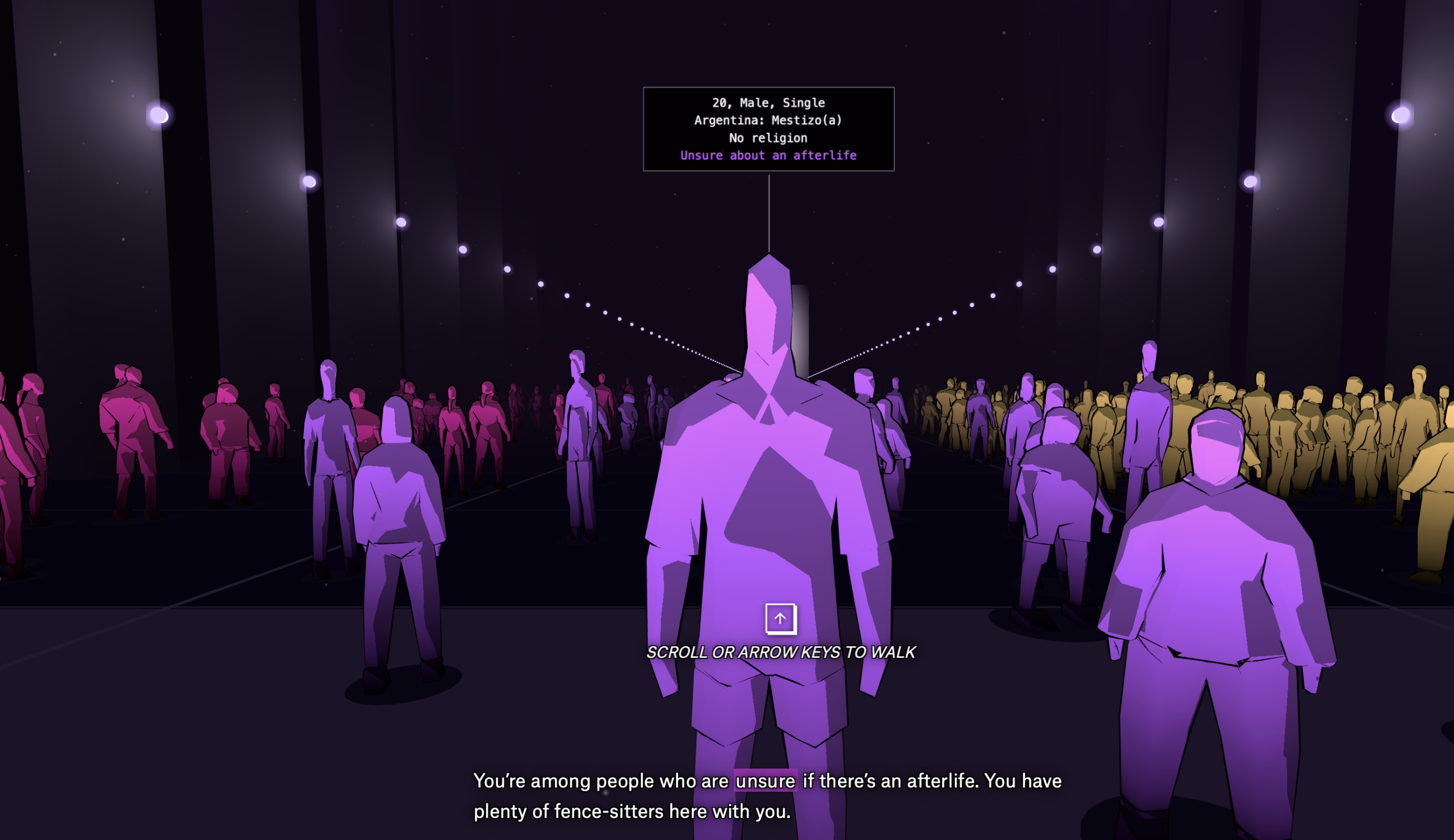
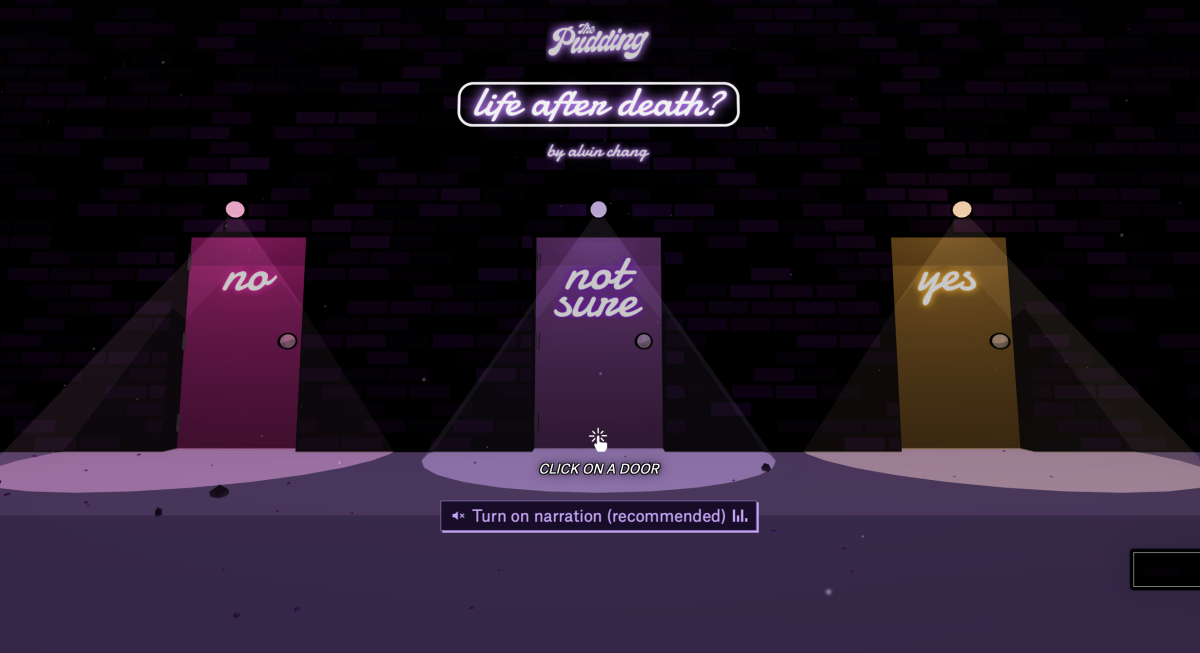
In Alvin Chang’s most recent project for The Pudding, “Life after Death?,” he challenges viewers to explore their religious or spiritual beliefs through an interactive experience. Before entering the virtual space, viewers are prompted to choose one of three doors based on their views regarding the afterlife.
Storybench spoke to Alvin Chang to learn about the creation of “Life After Death?” The following interview has been lightly edited and condensed for clarity.
What made you interested in pursuing a project like this?
There’s a few parts to it. One is I really like data that helps you see things that we don’t talk about every day. You forget that you don’t have opportunities to have these conversations about things that you probably think about as you’re falling asleep. I thought that was a really good opportunity to use some data to reveal some deep thoughts of a lot of people. It’s something that I wish I could have more conversations and prompts to talk about it.
The other thing is, I was walking through a cemetery in New York called Greenwood Cemetery. I remember thinking, wait, I weirdly feel less lonely about death being around all of these people who have experienced it and seeing how they are remembered now. Part of this prompt was what if we create an experience that lets you see what other people are thinking, but also walking through a cemetery. It is a weirdly therapeutic experience to be around people who have all died. I think beyond that, looking at how people think about something like the afterlife across a universal experience is something we don’t really get to. There are a lot of things that you can’t survey people about worldwide and get a response where you can relate to them in a certain way. Death is the ultimate universal experience.
When did you start this project and how did you integrate the data based on that?
The data is from a big study called the Global Flourishing study. This project uses two waves of data. The first one was from 2022 – 23 and then they surveyed the same people again a year later in 2024.The purpose of this data set was not to ask about the afterlife. That was just one of the questions that they asked. I only started this project about six months ago and really ramped up about four months ago to get this to the finish line. I always knew this data set existed. A lot of times as data journalists, we think “this is a cool data set, but I don’t have a use for it yet.” When I had this question about the afterlife or the story I want to think about, I knew that this survey might ask that question. So, when I found out it asked it, I was like, “Yes, like this is this is the chance to to use the survey data.”
Do you collaborate with other people to build your projects?
I typically build everything myself. It’s like I am a traditional journalist where I’m gathering information and reporting. It usually starts with writing but then usually the output is I have to turn it into this other thing. If you think about it in terms of this as a form of communication then we find a way to express it. It’s really important that I at least have some part in building it because just like with writing, you start to have different thoughts of things you want to express. I have the same experience while designing and coding and planning out these projects. This project starts with the user having to pick which door to go in. I’ve clicked on a door maybe hundreds or thousands of times because I’ve had to debug and create this experience. What does it do to a person when you have to pick which of these doors to go in? Then maybe I reshape the story around what that experience is.
What’s something that you learned either through like the visual experience or through the data that you were not expecting?
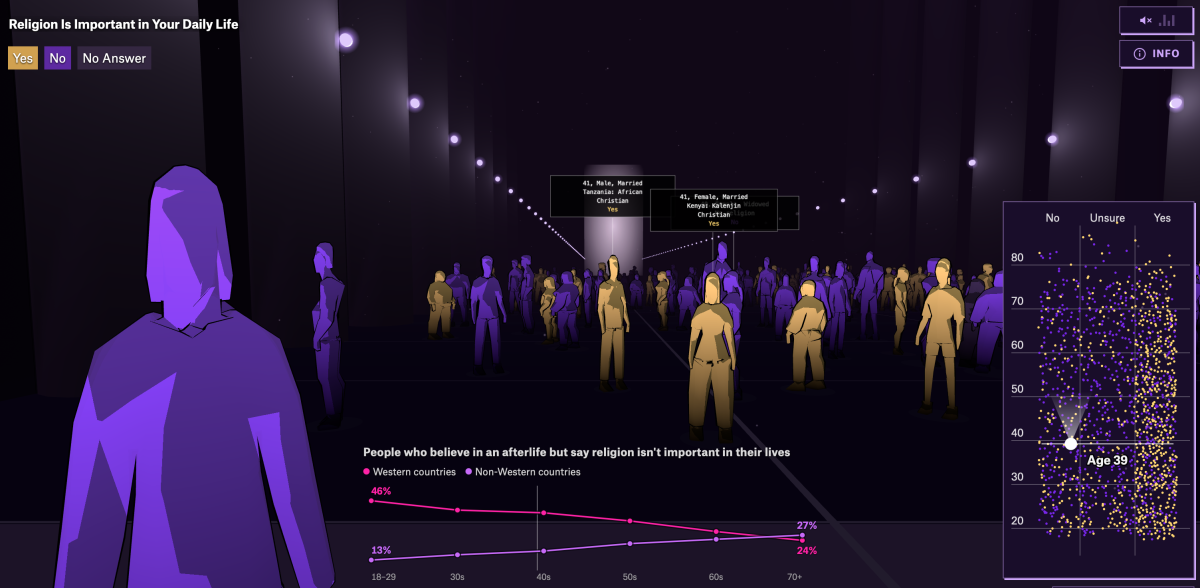
I think there’s two things. Going through the data, one of the really interesting findings that I kind of already knew is that our identities have nothing to do with the afterlife. The amount of trauma we experience, like going through a divorce, going through a breakup, educational experiences, have nothing to do with whether or not there actually is an afterlife. That makes perfect sense if you really think about our lives as this arc. What you believe comes afterward is based on experiences you have. When I was building the story, there was a sense of community around belief. I think a lot of times if you’re an outlier in a community of people who are believers or vice versa it can feel partially lonely. Obviously, you don’t get to meet them in real life, but that type of experience, I think, helps me understand who lives on this earth, and what we all think about. It’s easy for the people you encounter in everyday situations to be wrestling with really worldly things like immediate needs. Being in that room is almost this impossible space where all of us get some time to wrestle with this big question. I think it’d be great to wrestle with this question in peace without worrying about bills or all these other things in your life.
After creating this project, what are your beliefs about the afterlife?
I keep going into that “maybe” door. I think a big part of it is after seeing all of these people who have experienced a wide range of lives and realizing that people shift left and right across this room from belief to mostly belief or from disbelief to mostly disbelief. I find it really hard to be an absolutist about it. I think being absolutist by saying no closes off a lot of both human experiences but also intellectual exploration. My belief is it’s important for us to be flexible going left and right in this room and to be aware that it’s okay to change our mind. The only thing that we absolutely know is that we don’t know what’s on the other side. I think I keep going through that middle door because it feels like agency is not to be stuck in a part of that room that I don’t want to be stuck in. I feel a lot of sadness for people who don’t get to explore that. I know there’s some security in feeling like “yes this is where I am” but I think that middle ground is both intellectually and spiritually exciting and challenging.
Besides Global Flourishing, were there any experts or specific research that helped you bring this vision to life?
For every one of my stories I try to do a lot of reading. For this piece you can see a lot of the reading linked throughout. There’s three buckets of research. One is the more philosophical end of “Is there an afterlife? What does it mean?” There’s looking at what is belief but what do people believe? But not really digging into the why. A lot of that is like demographers who are like “what is the state of belief right now? What direction is it moving?” I think the last bucket is people who study the benefits or how belief manifests or lack of belief manifests into our lives whether it has a positive effect or negative effect. For example, in a lot of Western cultures, belief in an afterlife really has a huge effect in calming anxiety of death. It also tends to have the idea of a specific afterlife that will punish you for doing something wrong or reward you for doing something right does have some effects in how you behave. What’s different about this story for me compared to my other stories is the research ended up mattering a little bit less. It was more about you being able to walk anywhere in this room and be around whoever you want.
What about writing the narrative? How did you decide what was most relevant for people’s experiences?
In these pieces, I think about the structure of the story and how it can reflect the visualization. In this case, the structure of the story is: you go from young to old and then the narrative also does that. For me, the structure of your story has to relate to the structure of your visualization. I knew that I wanted to go from young to old because I think we have this idea hoping to grow old. We know when we grow old there is this end of some sort. From there finding the prominent data points in every decade and then building toward solidifying belief I think was the narrative that was in my head. Data doesn’t always cooperate with that narrative that you want to tell. In this piece, you see some of the data not cooperating halfway through or like people changing their mind because of traumatic experiences happening later in life.
How do you feel about this project compared to your past work?
I’ll give you two answers. One is, every time I work on a project, I want it to be the best thing I’ve ever done. In some ways this is the best thing I’ve ever done. Exploring a format, the concept of the forum, a big idea that I find meaningful making something where I could spend hours on myself. I think when it comes to definitions of more traditional success, does it say something really clear and help people learn something explicit? Does it comment on something happening in the world right now? Does it nudge the world very clearly with the theory of change in the direction that I want? No, it doesn’t do that. Which is kind of the opposite of things that I really valued in other projects. In this one, I took a different approach because my belief is that people should explore this space with full agency. The other answer is I was working on this project while finishing up a book that I’m writing that’s going to publish next year and the book is about mental mapmaking and how our minds are able to take a bunch of information and turn it into models of the world that help us understand how things work. I found it really rewarding to explore that idea while working on this book and then put it into play in this unrelated experience in a separate project.