Six reporting lessons from the Cornell sexual assault investigation
From student journalists who stayed with the story for nearly two years to national newsrooms parsing police interviews, Title IX records and court documents, coverage of the Cornell case offers lessons for reporters tackling sensitive, document-heavy investigations.
When a former Cornell University student filed a civil lawsuit in September alleging that she had been drugged and sexually assaulted by several fraternity members in 2024, the case quickly drew national attention.
But for reporters at student-run Cornell Daily Sun, the story wasn’t new.
Cereese Qusba, a senior editor, had been following the allegations long before the lawsuit brought reporters from national news organizations to Ithaca. After the lawsuit was filed, journalists at The New York Times, The Washington Post, CBS News, and other outlets have examined police interviews, court filings, Cornell disciplinary records, and statements from university and law-enforcement officials.
The reporting provides a useful case study of how journalists can approach a sensitive investigation when information is scattered across different institutions and multiple documents — and when those sources do not always provide the same picture.
Here are six pieces of reporting worth reading, and the lessons journalists can take from them.
1. Stay with the story after everyone else moves on
Read: “The Student Journalists Who Never Let the Cornell Assault Case Go,” Emma Goldberg, The New York Times
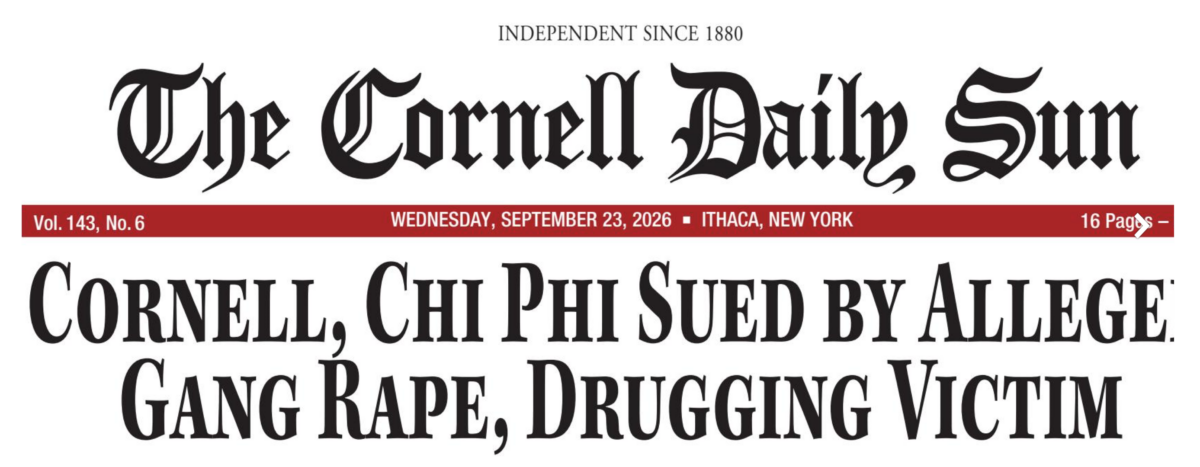
One of the most important reporting lessons from the Cornell case came before it became a national story. In her profile of The Cornell Daily Sun, New York Times reporter Emma Goldberg documented how student journalists continued pursuing the allegations long after a November 2024 campus crime alert first disclosed that a student had reported a sexual assault at a fraternity house.
Qusba continued reporting, developed sources, and monitored Cornell’s response. By the time a civil lawsuit was filed nearly two years later, the student newspaper already had significant institutional knowledge and sources connected to the case.
That persistence offers a basic but important lesson: accountability stories often develop on a much longer timeline than the daily news cycle.
A police alert, lawsuit or administrative announcement may suddenly make a story newsworthy nationally. But the relationships and background reporting built months earlier can determine who is best prepared to explain what happened when that moment arrives.
2. Show readers how the reporting was done
Read: “How We’re Reporting on the Cornell Rape Investigation,” Megan DiTrolio and Mike Abrams, The New York Times
The Times took another step after publishing its reporting: it gave readers a behind-the-scenes look at how journalists approached the investigation.
That kind of transparency can be particularly valuable in stories involving sexual assault allegations, contested accounts and documents produced by multiple institutions.
For reporters, explaining methodology is not merely a way to defend a story after publication. It can help readers distinguish between what a source alleges, what a document says, what journalists independently confirmed and what remains unknown.
That distinction becomes especially important when readers encounter vastly different versions of the same case on social media.
A useful practice for investigative reporters is to keep track not only of individual facts, but also of the evidentiary basis for each one:
- Who said it?
- What document establishes it?
- Has another source corroborated it?
- Is it an allegation, an institutional finding or an independently established fact?
That reporting trail can later help both editors and readers understand how the story was constructed.
3. Treat every document as one part of the evidence
Read: “Unsealed documents detail Cornell investigation into alleged rape at fraternity house,” Susan Svrluga, Todd Wallack and Amy B Wang, The Washington Post
The Washington Post’s examination of newly unsealed records demonstrates another challenge investigative reporters regularly face: different systems produce different kinds of evidence.
Cornell conducted a Title IX investigation. Campus police conducted a criminal investigation. Prosecutors evaluated whether criminal charges could be brought. Jane Doe later filed a civil lawsuit.
Those processes serve different purposes and use different procedures.
The university disciplinary records examined by the Post revealed details from Cornell’s investigation and hearings that had not previously been available in the public record. But a university investigation is not a criminal investigation. A civil complaint is not a finding of fact. And a police report may summarize information differently from the interview on which it was based.
That means reporters should not necessarily ask which document contains the definitive version of events. Instead, ask:
- Why was this document created?
- Who created it?
- Who was interviewed?
- What standard was being applied?
- What information did the decision-makers have at that point? And what might be missing?
Understanding the purpose of a document is part of understanding the document itself.
4. Go back to the original interview — not just its summary
Read: “Jane Doe in Cornell University case told campus police, ‘I can say with 100% confidence I was raped,”’ transcript shows,” Mahsa Saeidi, CBS News New York
CBS News New York investigative reporter Mahsa Saeidi obtained something particularly valuable: a transcript of Jane Doe’s November 2024 interview with Cornell University Police.
That transcript became important because prosecutors had received a six-page statement based on the interview. Tompkins County District Attorney Matthew Van Houten later told CBS that his office had not been given the full interview transcript.
In subsequent reporting, Saeidi and Walter Smith Randolph examined a 565-page appendix to Cornell’s Title IX investigation. It included interviews with Jane Doe, six of the seven men named in the lawsuit and 20 witnesses.
The reporting demonstrates a fundamental document-reporting principle:
A summary of a source is not necessarily a substitute for the source itself.
Whenever possible, reporters should try to get closer to the underlying material. If an official describes what someone told investigators, seek the interview. If an institution summarizes an investigation, seek the investigation. If a lawsuit references an email, photograph, text message or video, determine whether that evidence is available.
Primary records allow reporters to evaluate language and context themselves rather than relying entirely on another institution’s interpretation.
5. Build a timeline when the reporting becomes too complicated to hold in your head
Read: “‘I felt like bait’: A timeline of the Cornell University rape allegations,” Amy B. Wang, The Washington Post
By October, the Cornell story involved events stretching across almost two years: the night of the alleged assault, conversations afterward, a report to campus police, Cornell’s disciplinary investigation, hearings, prosecutorial decisions, a civil lawsuit and renewed scrutiny of the original criminal investigation.
The Washington Post organized much of that information into a detailed timeline based on court documents, institutional records and reporting. For journalists, timelines are more than a presentation format. They are a reporting tool.
Building one forces a reporter to establish:
- When did an institution first learn something?
- When did a witness provide an account?
- When did investigators obtain evidence?
- When did officials make decisions?
- And what information was actually available to them at that moment?
That last question is particularly important. Information discovered in 2026 might explain something that happened in 2024, but it would be misleading to imply that officials necessarily possessed that information when they made their original decision. Timelines help reporters separate what we know now from what someone knew then.
6. Verify identities yourself — especially when the internet starts investigating
Read: “He shares a name with a Cornell rape suspect. Strangers started hunting him down”, Todd Wallack, The Washington Post
The Cornell case also became an example of the dangers that emerge when crowdsourced internet investigations race ahead of professional verification.
Washington Post reporter Todd Wallack documented how an unrelated man who shared the name of one of the defendants was falsely identified online. He and members of his family received threatening messages after internet users connected him to the allegations.
The episode offers a particularly important lesson for reporters covering rapidly developing investigations:
Publicly available does not automatically mean verified. And publicly available does not automatically mean necessary to publish.
- Court documents can contain incorrect information.
- Two people can share a name.
- Social-media accounts can misidentify photographs.
- Addresses can be outdated.
- Screenshots can circulate without context.
- A professional newsroom should not outsource identification to internet crowds.
Before identifying someone connected to an allegation, journalists should independently establish that they have the correct person — and consider whether publishing additional identifying information serves a legitimate reporting purpose.
Bonus: Student journalists can uncover records national reporters miss
The Cornell case also demonstrates why student and local journalists can remain indispensable even after national news organizations arrive.
In October, Qusba examined an archived Cornell University Police daily crime log and found that officers had made a drug-related arrest at the Chi Phi house roughly 22 hours before the period in which Jane Doe alleges she was sexually assaulted.
The Sun combined the crime log with Cornell event information, the lawsuit and other records to reconstruct what university officials knew about activity at the fraternity house before the alleged assault.
That reporting illustrates an advantage local reporters often have: institutional knowledge. They know where obscure records live. They understand which offices are responsible for what. They know what procedures normally look like. And they may recognize the significance of a document that an outside reporter encountering the institution for the first time might overlook.
National outlets can bring considerable investigative resources to a major story. Local and student journalists bring something equally valuable: accumulated knowledge of the institution they cover every day.
A reporting playbook that extends beyond Cornell
The Cornell investigation is still developing, which means the journalism surrounding it will continue to change. But the reporting already offers a useful playbook for journalists covering institutional accountability:
- Stay with stories after public attention disappears, and build source relationships before breaking news happens.
- Seek the original documents behind summaries and official statements.
- Understand why each document was created before comparing it with another.
- Build a timeline early.
- Be precise about the difference between allegations, findings and independently verified facts.
- And never mistake information circulating online for information that has actually been verified.
Those practices are useful far beyond Cornell. They apply whenever reporters are trying to reconstruct a complicated event from incomplete records, competing institutional accounts and sources with very different perspectives.

- Six reporting lessons from the Cornell sexual assault investigation - October 27, 2026
- How Copernicus Makes Climate Data Simple and Easy to Understand - October 13, 2026
- The Rise of ‘Nano-Newsletters’: Why 500 Subscribers Beats 50,000 - April 14, 2026