What’s the real story behind the spread of AI data centers? It depends where you get your news.
Research by Adam Perhala
Artificial intelligence may live in the cloud, but the infrastructure powering it is very much on the ground. That split is reflected in the media’s coverage of the explosive growth of data centers.
In the national media, coverage focuses on the enormous amount of power required by AI and the companies racing to secure it. But local news coverage brings the question closer to home: Who is going to pay for all of it?
That’s the pattern we found using data analysis and topic modeling to examine 10,000 news articles that mentioned data centers in the first six months of 2026 in national publications and in three states that have seen rapid growth of new and proposed centers (read more on how we did it). The comparison suggests that geography changes the way the data center story is told.
National coverage tends to zoom out. Data centers become part of a larger story about whether the United States can produce enough electricity for AI, where that power will come from and how quickly a new generation can be built.
Local coverage zooms in. The same growth is more likely to appear through an electric bill, a transmission project, a fight over water or a zoning meeting.
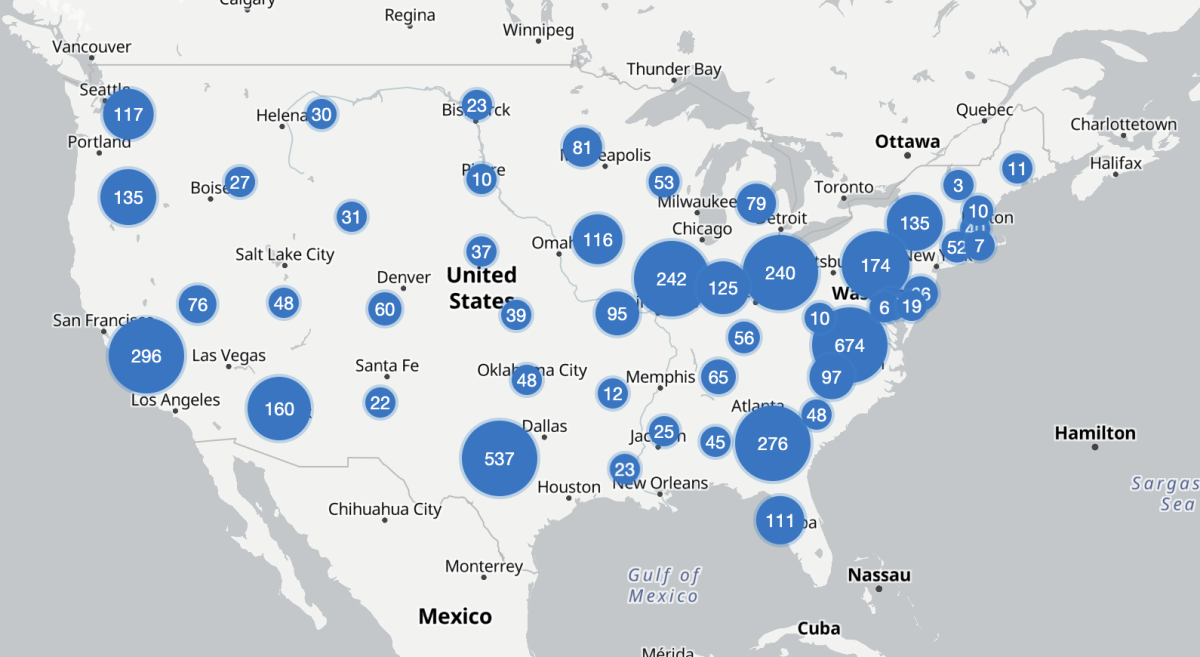
We looked at states in different parts of the country: Virginia, already the country’s largest data center market with 674 listed by the Data Center Map tracker, as well as Texas with 537, Ohio with 240. All have substantial data center footprints but very different energy systems, local politics and development patterns.
One recurring topic in local news articles we examined revolved around water, energy, cooling and use. Another centered on costs, electricity, energy, prices and utilities. In all of the stories, the same broad concern appeared again and again, but it took very different forms.
In Virginia, journalists were asking who should pay for the grid infrastructure required by data centers. In Texas, coverage increasingly focused on whether communities should provide the water, electricity and tax advantages that make development possible. In Ohio, reporters documented something even more tangible: new power generation, cooling systems and zoning rules being built around the industry.
The same boom becomes a different story depending on where you live
Virginia provides perhaps the clearest example of that shift. The state has the largest concentration of data centers in the country. Cost is a recurring theme in the Virginia coverage we reviewed, particularly the question of whether residents should pay for the infrastructure needed to support data centers.
That question appears directly in the coverage. In July, the Virginia Mercury published a story headlined, “SCC considers making data centers shoulder more of the cost of transmission lines.” The story reported that Dominion Energy was seeking to recover about $1.5 billion from customers for transmission-grid construction.
That turned what might otherwise sound like an abstract story about grid capacity into a much simpler question: Should households pay for infrastructure being built to serve data centers? “If corporations are going to run data centers in Virginia, they should cover the cost of them,” Sen. Mark Warner said. Virginia Gov. Abigail Spanberger’s administration took a similar position, and the State Corporation Commission ultimately ordered data centers to cover the cost of transmission infrastructure built exclusively for those facilities.
That language mirrors one of the clearest patterns we found in Virginia coverage. The question of who pays shows up repeatedly. Another Virginia Mercury story was headlined, “Legislature considers shifting power line costs from residents to data centers.” In the article, Sen. Russet Perry said the state needed to look at transmission lines driven by large energy users and make sure “they’re paying the fair cost of those.” The story is no longer only about how much electricity data centers consume. Increasingly, it is about how the costs created by that demand should be divided between the industry and everyone else.
In Texas, the cost debate expands beyond electricity
In Texas, the question of who pays takes a different form. Coverage is less centered on a single utility bill and more on the resources and public support that data centers require as they move into communities across the state.
Water is part of that story, but so are electricity, noise, tax incentives and local control over where data centers can be built. Those concerns show up directly in Texas headlines. One Texas Tribune story asked, “Texas leaders are asking data centers how much water they use. Most aren’t responding.” Another was headlined, “Abbott recommends sweeping data center regulation, including eliminating sales tax exemption.” The issues have increasingly turned data center development into a political question about what communities are expected to provide and what developers should be required to bring themselves
That framing became particularly explicit in a Texas Tribune story about data center development in rural communities. Gov. Greg Abbott said the facilities should “bring their own money, bring their own power, reuse their own water” and reduce electricity costs for residents. He also called for eliminating their tax breaks and requiring developers to fund their own projects.
That broader focus also appears in local coverage. KERA News reported on a Hood County town hall under the headline, “Hood County AI data center town hall draws bipartisan concerns over water, noise and local control.” Residents, local officials and political candidates gathered to discuss proposed data center developments in the county. “This is about the people here in rural Texas,” Hood County GOP Chair Greg Harrell told KERA. The story puts water, noise and local control at the center of the debate, bringing the questions around data center growth down to the communities where the projects are being proposed.
Similar concerns appeared in Community Impact’s coverage of a proposed data center in Round Rock. In “Round Rock officials weigh neighborhood compatibility for Skybox data center ,” the outlet focused on a project bordering the Chandler Creek neighborhood, where residents raised concerns about noise as well as the facility’s energy and water use.
In Ohio, the cost is built into development itself
Much of the coverage in Ohio followed data centers through the mechanics of local development: zoning decisions, project approvals, tax incentives and the new infrastructure needed to make unusually large electricity loads possible.
In Pataskala, for example, coverage of a proposed data center described a project requiring as much as 200 megawatts of power. Plans included closed-loop cooling and on-site power generation, bringing questions about energy and water directly into discussions over whether and how the project should be built.
In New Albany, officials approved plans for a 250-megawatt natural-gas power facility designed to operate behind the meter for a data center development, along with 116 megawatts of battery storage. Instead of treating rising AI electricity demand as a distant problem for the regional grid, stories like this make the infrastructure itself part of the development.
Other Ohio coverage gets even more local. In Canton, the debate centered on rules governing where data centers could be located, including setbacks, noise, landscaping and protections for sensitive sites.
National coverage tells a different story
Zoom out to national coverage and much of this local texture disappears. The national stories in our dataset more often connect data centers to financial markets, corporate investment, AI growth, electricity demand and the race to secure enough power to support it. Companies, deals and infrastructure investment become central characters in the story. That framing shows up directly in national coverage. Reuters reported on “Google, Blackstone to launch AI cloud venture to meet data centre demand,” a deal involving an initial $5 billion investment from Blackstone and potentially as much as $25 billion overall. The Washington Post approached the boom from the infrastructure side with “Silicon Valley is building a shadow power grid for data centers across the U.S.,” describing tech companies building their own power plants as data center development expands across the country.
That does not mean national outlets ignore the costs of data center expansion. Energy demand and grid capacity are major parts of the coverage. A Washington Post story about the proposed merger of NextEra Energy and Dominion Energy put that demand at the center of the deal. “Electricity demand is rising faster than it has in decades,” NextEra CEO John Ketchum said in the statement. “Customers need affordable and reliable power now, not years from now.” But the scale changes. A new power plant can become a story about meeting future AI demand, locally, the same kind of infrastructure can become a debate about zoning, noise, water, electricity bills or who should pay for it.
That difference matters because both versions of the story can be true at the same time. The billions of dollars flowing into AI infrastructure nationally are connected to the transmission lines being debated in Virginia, the fights over resources and development in Texas and the power and zoning decisions taking place in Ohio.
Whose voices get heard?
If national and local outlets frame data centers differently, is it because they’re talking to different people?
Residents appeared more often in local coverage than in national stories. They made up 11.6% of the sources in Ohio coverage and 10.2% in both Texas and Virginia, compared with 6.9% nationally. Corporate spokespeople showed the opposite pattern, appearing more prominently in national coverage than in any of the three states.
Overall, national coverage often tells the data center story through companies, investment and the infrastructure needed to support AI growth. Local reporters are more likely to bring the story down to the people living alongside that development, giving residents a larger role in explaining what new data centers could mean for their communities.
Who pays for the AI boom?
The same data center boom can look very different depending on where the story is told. Nationally, the focus is often on investment, energy demand and how quickly the country can build enough power for AI. Locally, those questions become much more tangible: an electricity bill, a water supply, a zoning decision or a new power plant.
Our analysis suggests that geography does not just change where the data center story happens. It changes what the story is about and whose costs become visible.

- What’s the real story behind the spread of AI data centers? It depends where you get your news. - September 22, 2026
- How we’re using topic modeling to understand news coverage of data centers - September 22, 2026
- Where Should Data Journalists Be This Spring and Summer? - May 6, 2026