Horror Beyond the Jump Scare
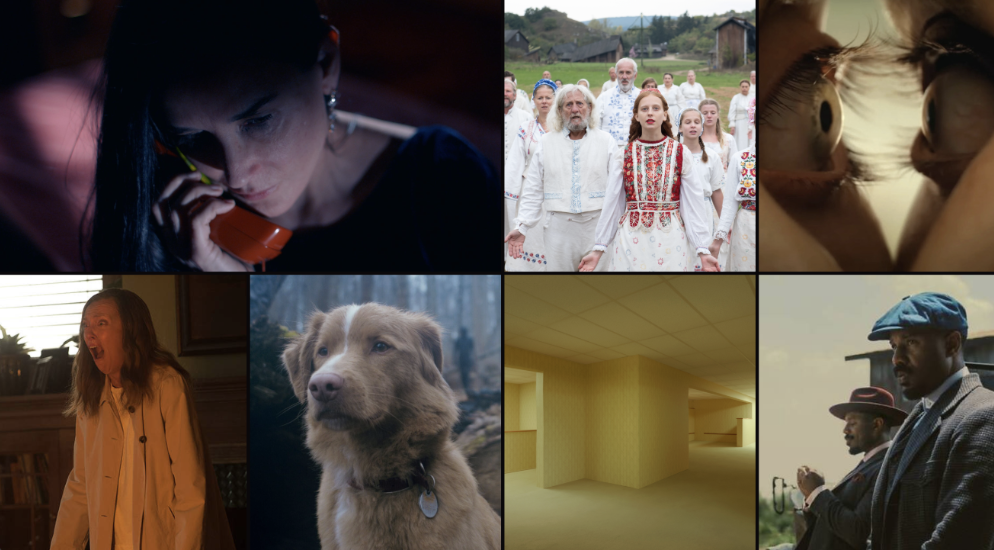
Scary movies can be much more than a monster hiding in the dark. That’s the surprise hidden in several recent horror films that are pushing the boundaries of the genre. And while horror has always borrowed from drama, satire and fantasy, what is drawing attention now is the range of stories being told through those older forms, along with the audiences and awards some of these films are finding. A comparison of IMDb ratings shows a curious split between horror as a whole and a handful of its more unconventional successes, with audiences giving higher ratings to genre-bending and blending films.
In “Together” , a couple struggling with their relationship finds themselves drawn together in a disturbing and increasingly physical way. “The Substance” turns the pressure to stay young into grotesque transformations. In both, the horror is inside rather than an outside force.
In “I Saw the TV Glow,” Owen (Justice Smith) grows close to another isolated teenager through a cult television show. Their obsession with its fictional world is both comforting and frightening. Schoenbrun turns what could have been a simple supernatural mystery into a story about the difficulty of recognizing who you are. “To call it horror seems reductive,” wrote Wendy Ide in The Observer about Schoenbrun’s film.
That approach has something in common with the filmmakers using grotesque physical changes to tell stories about aging and relationships. Both kinds of horror leave audiences with more to argue about than whether the movie was scary.
A Different Kind of Horror
In many horror films, the danger is a killer, a ghost or something hiding in the dark. In body horror, the danger is often the body itself. Skin changes, limbs twist and people lose control of what is happening to them. The shock comes from watching a fear that is usually invisible take physical shape.
The idea is hardly new. David Cronenberg, a Canadian film director and screenwriter, helped establish body horror with films including “The Fly”, in which a scientist slowly transforms after an experiment goes wrong. That mixture of physical horror and emotional pain runs through some of the genre’s newer films.
Coralie Fargeat brought that tradition into the beauty industry with “The Substance” (2024). Demi Moore plays Elisabeth Sparkle, a television fitness star who is fired as she turns 50. Desperate to hold on to her career, she tries a mysterious treatment that creates a younger version of herself, Sue (Margaret Qualley). The two are supposed to share their time equally, seven days each. That simple rule becomes impossible to keep as Sue takes over Elisabeth’s old life.
Fargeat drew on her own fear of aging. In an interview with ELLE, she described the shock of turning 40 and worrying that society would no longer value her. The movie makes those thoughts brutally literal. Bodies are cut, stitched and transformed; a woman’s private fear of no longer being attractive becomes something the audience cannot look away from. Reviewing the film for RogerEbert.com, Monica Castillo called it a “blood-and-neon drenched spectacle.”
Before its Cannes premiere in May 2024, Mubi acquired “The Substance” for the United States and several other territories. The film won the festival’s screenplay award and opened in U.S. theaters that September. Its advertising was as strange as its premise: rather than putting Moore and Qualley’s faces on the posters, the campaign used images of objects from the film, including a chicken bone and a bright pink exercise leotard, according to Deadline. Moore also promoted the film on social media. According to The Numbers, whose box-office figures we use throughout this story, the film earned more than $77 million worldwide, becoming a major box office success for Mubi. Moore later won a Golden Globe for her performance.
Michael Shanks took a different anxiety into body horror for his first feature, “Together”: what happens when two people have been a couple for so long that they cannot imagine life apart? Shanks told Sundance that the idea came from his relationship with his partner of 15 years. He imagined falling in love not just as an emotional change but as a physical one.
The movie stars real-life married couple Dave Franco and Alison Brie as Tim and Millie. He is a struggling musician; she is a teacher. Their move to the countryside has done little to fix their problems, and after a strange encounter underground, their bodies start pulling toward each other. What begins as an uncomfortable metaphor for codependency turns into a series of painful attempts to separate.
“Together” premiered at Sundance in 2025, where Neon acquired its worldwide rights after a bidding war. The distributor released it widely in U.S. theaters that summer. The stars’ real-life marriage became part of the publicity, as Brie and Franco knew audiences would bring their knowledge of the couple to the film. It earned about $34.6 million worldwide. Franco told The Guardian that single viewers had called it an argument for staying single, while one couple said the movie helped them make up after a fight. Other audiences found the ending either romantic or horrifying. “We find it optimistic,” Brie said.
There is a reason those reactions are so different. The terrifying idea in “Together” is also the idea at the heart of a long relationship: two people becoming part of each other’s lives. The film simply takes it further than anyone would want to see.
Rewriting the Slasher
A masked killer, teenagers in danger and a remote summer camp have been familiar parts of slasher movies since “Friday the 13th” (1980). Jane Schoenbrun is interested in those conventions, but also in the people who grow up loving them. Their new film, “Teenage Sex and Death at Camp Miasma,” is about a director who gets the chance to remake the sort of horror film that shaped her.
Hannah Einbinder plays Kris Williams, a rising filmmaker hired to revive the fictional Camp Miasma franchise. Her first move is to track down Billy Presley (Gillian Anderson), the reclusive actress who played the original movie’s final girl. Kris goes looking for a star to cast, but her fascination with Billy soon makes the project more personal than she expected. The story keeps the slasher’s blood and camp setting while making room for desire, fandom and queer identity.
“Camp Miasma” opened the Un Certain Regard section at Cannes in 2026 and received positive reviews from critics. It earned about $8.5 million worldwide. The film also found an enthusiastic cult audience. Vulture reported fans arriving at screenings in homemade camp shirts, fake blood and costumes inspired by its fictional killer. That kind of response is harder to capture with a box-office total alone.
The Numbers Behind the Scares
In an analysis of feature films released from 1980 through 2025 with at least 1,000 votes, horror had the lowest median rating among the major genres compared. One possible reason is that horror divides viewers more sharply than other genres. A 2025 YouGov poll found that nearly half of Americans disliked or hated horror, more than any other genre surveyed. Preferences also varied within the genre, with psychological horror attracting considerably more fans than body horror.
In part, it’s a reflection of how crowded the market has become. “Suddenly there’s a new horror film every week,” audience researcher Kevin Goetz told Variety in July 2025. Exhibitor Mike Barstow said audiences were tired of “mediocre entries.” Their comments concerned box-office results, not IMDb scores, but they suggest one reason so many releases struggle to stand out.
The second chart tells a different story. Seven unconventional horror films, including “The Substance,” “Hereditary,” and “Midsommar,” all score above the 5.9 IMDb median for horror films with at least 10,000 votes. Their ratings range from 6.4 for “Titane” to 7.8 for “Obsession,” showing that films that challenge the genre’s conventions can also earn strong audience ratings.
A New Generation of Horror Fans
Horror is becoming increasingly popular, especially among younger audiences. According to Ampere Analysis, 13% of Americans aged 18 to 24 named horror their favorite movie genre in 2024, making it the most popular genre among this age group. Horror’s popularity has also grown among Americans overall, while recent theatrical releases show just how strongly some unconventional films appeal to younger moviegoers.
According to the Los Angeles Times, both “Backrooms” and “Obsession” drew overwhelmingly younger audiences. Both films were made by young directors who had already built followings on YouTube, but their approaches to horror could hardly be more different.
“Backrooms” began with a grainy image of an empty, yellowish room shared online in 2019. Three years later, teenager Kane Parsons turned the idea into a found-footage video on YouTube, then a series. His A24 feature follows Clark (Chiwetel Ejiofor), the owner of a struggling furniture store, who discovers a doorway into an apparently endless maze. The carpets, yellow walls and fluorescent lights look ordinary, yet the rooms seem to go on forever. It is an example of liminal horror, in which a familiar-looking place becomes unsettling because something feels wrong. In an interview with Variety, Parsons said he wanted the film to explore the characters’ lives more deeply than his web series could.
The New Yorker’s Justin Chang admired the film’s eerie atmosphere, though he thought it became less frightening when the story started explaining its mysteries. That tension between keeping an internet legend mysterious and building a feature-film plot is part of what makes “Backrooms” interesting. The film became a major box office success despite its modest production budget. Parsons was just 20 when he made his feature-directing debut.
“Obsession,” the highest-rated film in our selected IMDb chart at 7.8, begins almost like a romantic comedy. Bear (Michael Johnston) is too nervous to tell his friend Nikki (Inde Navarrette) how he feels. A wish turns their friendship into something frightening. Barker told Focus Features that he likes finding horror in stories that seem ordinary at first.
Like Parsons, Barker first built an audience on YouTube with comedy sketches and low-budget horror films. “Obsession” premiered at the Toronto International Film Festival in 2025, where Focus Features acquired it for a reported $15 million. Made for just $750,000, the film went on to earn more than $500 million worldwide. Writing in The New Yorker, critic Justin Chang described the rise of Barker and Parsons as a “Zoomer-Horror Renaissance.”
That commercial appeal also has a cost. In The Guardian, Gwilym Mumford welcomed the success of young horror filmmakers but worried that studios might take fewer chances on original comedies, romances and dramas. His question was pointed: “Why does it always have to be horror?” The genre may offer room for creative risks precisely because it already has an audience studios know how to reach.
From Cannes to the Oscars
Hollywood’s awards season has traditionally been less welcoming to horror. Before “The Substance,” only six horror films had received Best Picture nominations, according to Reuters. That made the film’s five Oscar nominations in 2025 notable, particularly after its Best Screenplay win at Cannes. It ultimately won for makeup and hairstyling.
A year later, Ryan Coogler’s “Sinners” broke the Oscar nomination record with 16 nominations and won four awards, including Best Actor for Michael B. Jordan and Best Original Screenplay for Coogler. Amy Madigan also won Best Supporting Actress for “Weapons.” In The Guardian’s Oscars roundup, critic Benjamin Lee described it as a “scary good night for horror.” His colleague Owen Myers pointed to Madigan’s win as a sign that an unusual performance in a genre film might finally get more serious consideration.
- Horror Beyond the Jump Scare - October 29, 2026
- How AI Slop, Agents and Vibe Coding Are Going Mainstream - October 23, 2026
- What’s the real story behind the spread of AI data centers? It depends where you get your news. - September 22, 2026