The Power of Words: Trump on Twitter
Social media is a powerful tool that can be used to bring people together, but it can also incite violence. Public figures wield social media as a weapon to influence people’s behaviors and beliefs. Twitter is particularly effective in inciting violence because of how easy it is to mass share information through the retweet feature.
Twitter has been used as a way to “detect changes in attitudes that lead to the formation of mass public opinions, including hate toward specific groups,” according to a study published on April 07, 2021, by the American Journal of Public Health.
Certain political leaders know how to influence their followers to form extreme opinions against a certain demographic better than others.
Donald Trump has weaponized Twitter to achieve his political goals and incite his own personal prejudice against Asian Americans amongst his followers. His words have provoked violence in the past, such as his speech on January 6th of 2021 that prompted Trump’s supporters to attack the United States Capital. He was subsequently suspended from Twitter because of his tweets inciting violence leading up to the insurrection at the capitol.
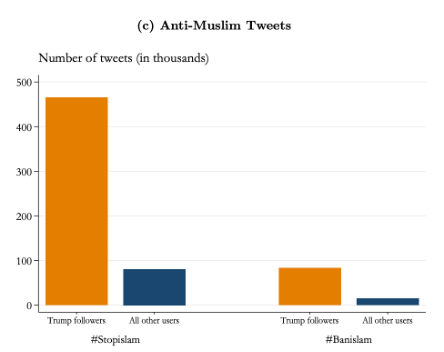
Prior to the pandemic and subsequent increase in anti-Asian hate crimes, Trump’s Tweets have also been found to rouse anti-Muslim hate crimes according to a study published by the Social Science Research Network. They used FBI anti-Muslim hate crime data and compared the number of daily hate crimes to the number of Trump’s anti-Muslim tweets from July 2015 to January 2018. The study found that with an increase in anti-Muslim Trump tweets, there was a rise in Muslim hate crimes. Furthermore, Trump’s Twitter followers tweeted significantly more anti-Muslim tweets compared to all other users (fig.1).
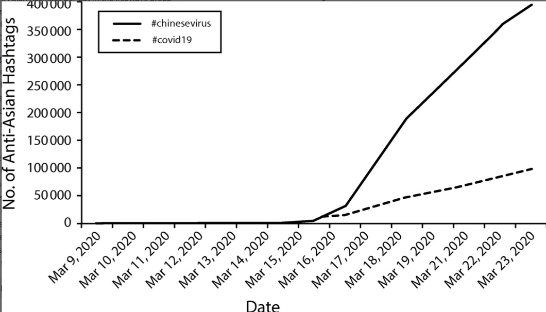
The same pattern can be found when comparing Trump’s tweets containing the term “China Virus” with Asian American hate crimes. On March 16 of 2020, Trump posted his first tweet with the term “Chinese Virus.”
Trump’s Tweet quickly went viral as users were exposed to it either through direct interaction with his account or indirectly through the 47.9K Retweets and 242.8K likes it has gotten. As the popularity of the term rose on Twitter, more covid related tweets had anti-Asian hashtags embedded within them; hashtags such as, “#bateatingchinese, #yellowmanfever, #makethecommiechinesepay, #disgustingchinese, #commieflu, #chopstickchins, and #chinkflu” determined by an American Public Health Association study analyzing the Association of “#covid19” Versus “#chinesevirus” With Anti-Asian Sentiments on Twitter: March 9–23, 2020. The number of anti-Asian tweets rose exponentially on March 17 of 2020, the day after Trump’s first tweet with the term “Chinese Virus” (fig2).
Out of the total number of tweets between March 9 and 23, 2020, 33% of tweets containing #chinesevirus also contained anti-Asian hashtags and 16.5% of tweets containing #covid19 also contained anti-Asian hashtags (fig3).
The more the term “China Virus” was tweeted, the more Anti-Asian hate crimes rose. The Hate Crime Statistic Act (28 U.S.C. § 534) defines hate crimes as “crimes that manifest evidence of prejudice based on race, gender and gender identity, religion, disability, sexual orientation, or ethnicity.” In 2020, anti-Asian hate crimes had increased by 146% compared to 2019 and in 2021 Anti-Asian hate crimes increased by 164% according to the Center for the Study of Hate and Extremism’s analysis of official national police data.
In this environment of increased violence, many Asian Americans reported worsening anxiety and depression because of the unprecedented rise of anti-Asian racism, with “72% of those who reported discrimination to Stop AAPI Hate (SAH) endorsed that discrimination was a significant source of stress for them, greater than all other pandemic stressors” according to an Asian American Covid-19 Needs Assessment executive summary released on May 26, 2021.
Mandy Lin is an Asian American who lives in Philadelphia’s Chinatown. She was interviewed by Jack Healy in his New York Times article “For Asian Americans Wary of Attacks, Reopening Is Not an Option” published in June 2021. The country was beginning to reopen, and most people were embracing the freedom, but Lin and her family continued to lock down not for fear of the virus, but for their safety from violent attacks. She told Healy, “It’s not safe to be outside. There has just been unending violence and harassment.” Lin has a 9-year-old son who is struggling at online school, while the rest of his classmates are in person. The risk of her son getting bullied or violently harassed has prevented Lin from sending her son back to school.
As others were moving on, Asian Americans were frozen in time because of paralyzing paranoia preventing many from rejoining the public explained Lily Zhu to Healy. Zhu stopped taking the bus out of fear of a violent attack.
The fear imposed on many Asian Americans further isolated them, and in turn, many felt their mental health was negatively impacted. Trump’s tweets broadcasting his personal prejudices against China provoked racist rhetoric online which translated into physical violence against Asian Americans.
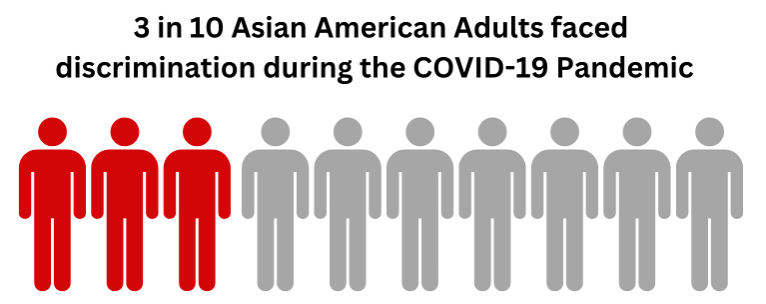
Figure 4: created by Julia Laquerre
My Story’s Social Media Plan is to implement the words “chinavirus” or “Chinese virus” as flags that inform a Twitter regulator that a Tweet includes those words. The reviewer would assess whether the Tweet is hate speech or not. Based on how severe the hate speech is, the regulator will either delete the Tweet or flag the Tweet with a banner stating, “This Tweet contains Hate Speech.”
Figure three was created using data from the study Association of “#covid19” Versus “#chinesevirus” With Anti-Asian Sentiments on Twitter: March 9–23, 2020, published by American Public Health Association. I used the total number of hashtags from March 9 to 23, 2020 from each of the hashtag groups. The #covid19 group had a total of 495,289 hashtags with 97,869 of them containing anti-Asian sentiment (19.7%). The #chinesevirus group had a total of 777,852 hashtags with 391,957 of them containing anti-Asian sentiment (50.4%).
Figure four was created using data from the Asian American Covid-19 Needs Assessment executive summary released on May 26, 2021.
Figure five was created with the Federal Bureau of Investigation’s hate crime data. I examined the number of FBI-reported anti-Asian hate crimes. This data is not comprehensive for all instances of anti-Asian hate crimes in the United States as many hate crimes are not reported for investigation or conviction.

- The Power of Words: Trump on Twitter - July 24, 2026
- Liza Donnelly on the power of cartoons - March 12, 2023



Yeah, the retweet feature really is a problem—it’s way too easy to amplify stuff without any friction. Didn’t realize there was actual research showing the correlation between Trump’s tweets and hate crimes though, that’s pretty wild.