How Lam Thuy Vo turned the chaos of infertility into a story of data, play, and hope
When Lam Thuy Vo started tracking her IVF cycle data in spreadsheets (needles administered, follicle counts, hormone levels), she wasn’t thinking about a story. She was trying to impose order on something that felt completely out of her control. But that instinct to quantify, to make sense of chaos through data, became the backbone of one of the most formally inventive pieces The Pudding has published in years.
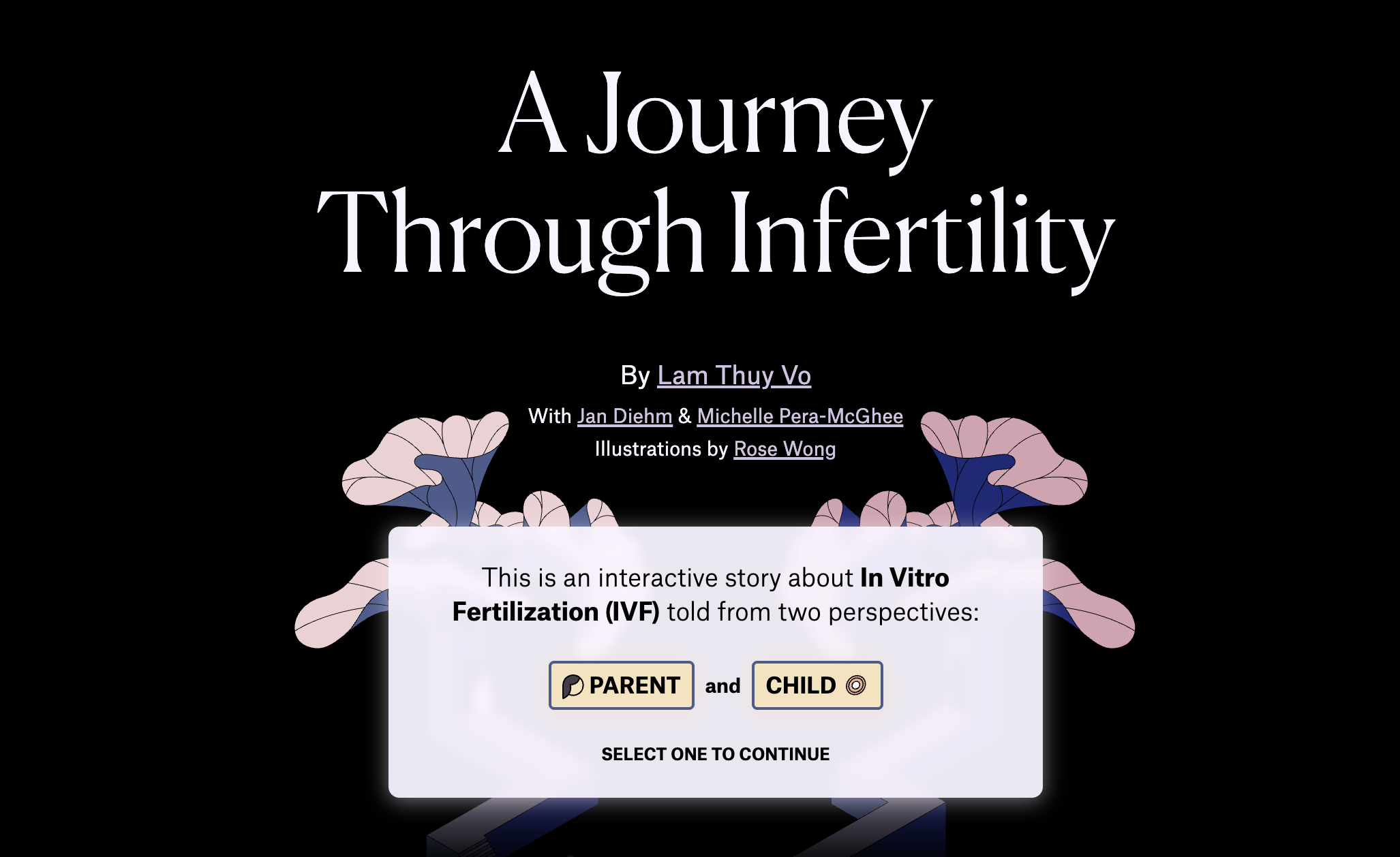
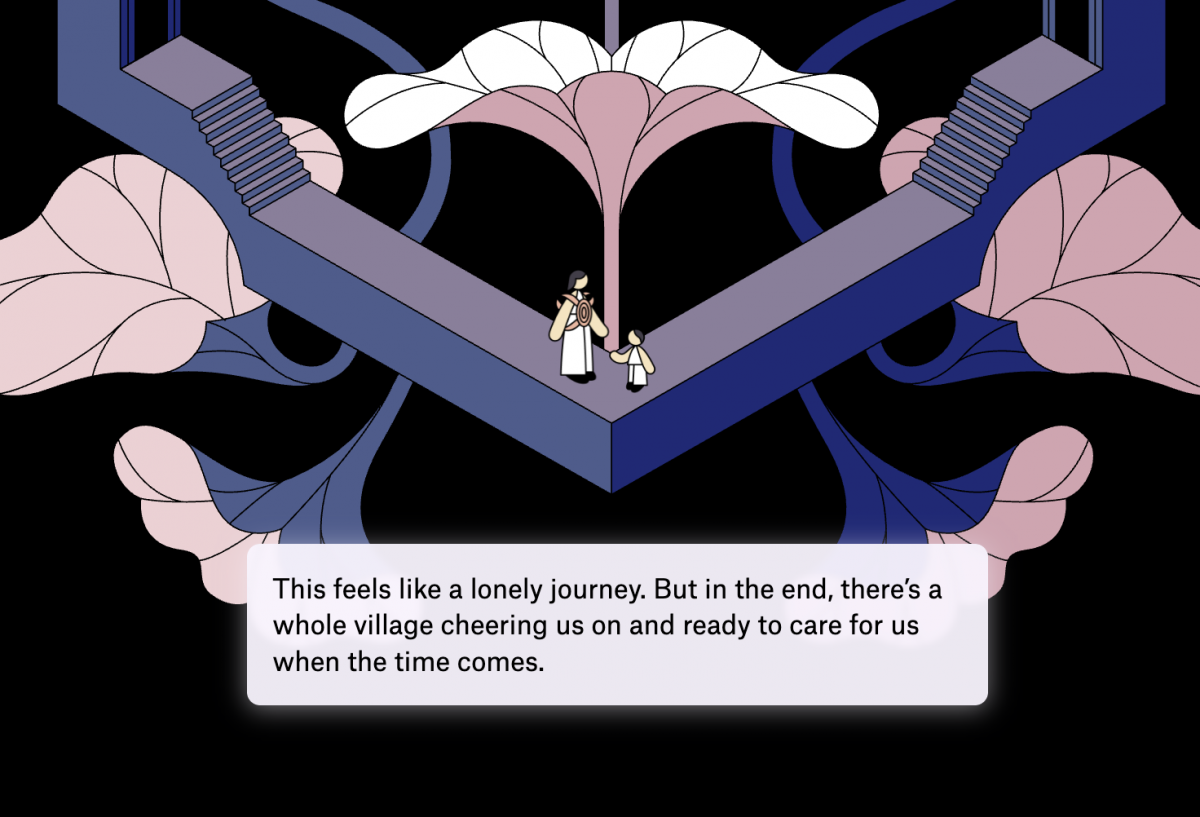
“A Journey Through Infertility”, published in March 2026, is an interactive story about in vitro fertilization told from two simultaneous perspectives: Parent and Child. Readers choose which path to follow, navigating an isometric world rendered in the style of the mobile game Monument Valley, with optional “deep dive” data sections tucked away like side quests. The piece is co-created by Vo, a data journalist and professor at the CUNY Graduate School of Journalism, alongside The Pudding’s Jan Diehm and Michelle Pera-McGhee, with illustrations by Rose Wong.
Storybench spoke with Vo and Diehm about how the piece came together, from the first messy draft to a year-long collaboration shaped by personal stakes, rigorous fact-checking, and a shared commitment to making IVF feel like something a general reader could actually move through.
This story is rooted in your own IVF journey, Lam. What made you decide to tell it publicly, and through The Pudding specifically?
Lam Thuy Vo: I had been very transparent about my IVF journey with my friends, because I realized that a lot of women were going through this by themselves. It is quite a difficult process. There are many highs and lows emotionally, a lot of jargon, and it can be financially challenging. There wasn’t much community around it.
I wanted to use a very personal way into the topic, and through my own story, help other people understand the process, whether it’s people going through IVF themselves or people who have a loved one going through it. I was hoping we could balance the scientific and logistical side with the personal side. My main goal was to help other people find themselves in this story, or help them better support someone in their lives who’s undergoing IVF right now.
The dual Parent/Child path is the first thing a reader encounters. Where did that structural idea come from?
LTV: I wrote a first draft, and then it was actually Jan’s idea to structure it this way. I’ll let her talk.
Jan Diehm: I read the first draft and was just struck by these parallel things that were kind of hidden within the words. This general sense of searching really resonated with the storytelling. I was also working on a separate project that had two parallel paths, so we had started talking about that. And then Lam mentioned Monument Valley. It was like worlds colliding: all the right inspiration, all the right metaphors, visuals, and data to pull it together.
The child side was initially meant to be more of a science explainer, following the journey from follicle to egg to embryo. But at some point we rewrote it with more of a child’s voice, to really hammer home that distinction. Every time we got together to collaborate on the story, it got better. That was just the power of a team of women who were all connected to the subject matter.
This topic is both data-heavy and deeply personal. How did you hold those two things at the same time? Did one ever threaten to overtake the other?
LTV: Jan and I bonded over this. I do quantify a lot of my personal experiences. I started by quantifying a big breakup in my 20s, and I’ve always kept spreadsheets. When I was going through IVF, I tracked how many needles I’d administered. Putting an order to that chaos was really helpful for me.
In my first draft, I was always struggling with telling the personal story and then shoving in: here’s the larger picture, here’s what fertility statistics look like. The personal story needed more general information to become more relatable, but the general information needed the personal story to have any emotional weight. What we landed on was this very personable character walking through her journey, and all the broader context hidden in what we called the deep dive.
JD: Once we leaned into the video game metaphor, the deep dives became like side quests. The main path gives you a complete, fully fleshed out story. But if you choose to explore, you get a much more well-thought-out universe. It was about giving readers a value add if they wanted it, without bogging them down if they didn’t.
How did you approach translating complex medical information into something accessible without losing the emotional thread?
LTV: I had been doing intense research this entire time, because that’s what you do as a journalist with anxiety. Every time my doctor performed a procedure, I would ask them to explain it. Then Jan did additional research. We worked with an IVF doula I’d been with for two years, who helped fact-check the piece. We also ran it by clinical staff at my fertility clinic, my doctor, and my OB-GYN.
JD: On The Pudding side, we sent it through a sensitivity read, which we sometimes do when a story is higher stakes. And this is higher stakes: you’re telling people medical information that could make or break a life. For fact-checking the graphics, my guiding question was: can I find this in multiple reputable places? If a professional society, a peer-reviewed source, and a doctor all said the same thing, that was my signal of safety in numbers.
Every chart type in the deep dives is different. Was that intentional?
JD: I went back through all the charts and data dives recently and realized we only repeat one chart type across the entire piece. That’s actually pretty rare. Data journalists often reuse chart types to help audiences build familiarity with a format. In this case, the guiding principle was that the deep dive needed to feel like a value add every time you opened one, something new and engaging. So all the chart types are different.
For the overall visual world, Lam had found illustrator Rose Wong, whose style matched really well with what we were building. We essentially wrote out a script: this is the text, and this is the visual we want to go with it. Rose took that and amplified it. One thing Lam kept emphasizing was that she didn’t want it to be dark and devoid of hope. We were initially working with a darker color palette, but it got infused with pinks, purples, and florals. That symbolism helped elevate it from dark and murky to dark and hopeful. When I was talking to Rose, I kept saying: what we want to capture is the energy of a sunrise. It’s still dark, but you’re starting to see the light.
Monument Valley shows up in the credits. How did that visual reference enter the project?
LTV: The whole journey of IVF, both for the child and for the mother, feels like a video game where you constantly have to keep going and there’s always something new to overcome. The idea of having to solve a puzzle while traversing these difficult landscapes was something I thought Monument Valley did really well. It struck a nice balance between a video game and something with a lot of emotional depth. We’re talking about motherhood, one of the most fundamental human experiences. I wanted something that felt gentle but still captured this long, drawn-out journey.
JD: I had played Monument Valley probably ten or fifteen years ago and stored it somewhere in the back of my brain. When we started talking about parallel paths, Lam brought it up, and I replayed it to really understand the mechanics: what you’re trying to do as a player, what the puzzles feel like, what kind of obstacle mechanisms we could use in our SVGs. I always find that whenever I’m working on stories, it helps to immerse yourself in whatever you’re telling. I’d never read a romance novel before I did a story on romance novel covers. And then I read a bazillion romance novels.
Was there anything you had to cut that you wish had stayed?
LTV: I really was hoping that by the end of the piece, I would be pregnant. That would have made for a very nice round ending. But there’s only so much you can do to fight nature. And I actually think in some ways, the suspense is more honest. The story hangs at this cliffhanger: are they going to be, or not? That’s actually a more accurate encapsulation of what people going through IVF feel, because you never know if it’s going to work. The hardest part of IVF is the not knowing, the hanging on to hope.
How has the response been since publication?
JD: I had people I hadn’t spoken to in years reaching out: “my daughter went through this,” “this is my own journey,” “thank you.” Women in their 60s, women in their 20s. Several men too, which was really lovely. At The Pudding, we don’t really track page view metrics. The way I’ve come to define success is: if a story organically makes its way back to me without me prompting it, something landed. The measure of success is whether a story can cross over into people’s real day-to-day lives. What Lam has built and is still building, the community around this piece, is the most powerful evidence that it did.
LTV: Before the piece even published, someone had found it and shared it on the IVF subreddit. It was like: it’s already found the right people. Everyone was saying it encapsulated what they were feeling, that they could see themselves in it. I hope it stays a resource for a long time.
The Pudding is known for taking on topics that get overlooked in data journalism. What does it mean to you that a piece like this exists in that space?
JD: Data journalism has historically been very white and very male-centered. I hope we’re one small cog in the wheel that helps correct that imbalance. The more we can understand about ourselves, the better equipped we are to understand the world around us. The representation matters.
LTV: IVF is something most people have either lived or know nothing about. I’ve been very upfront about my journey with everyone in my life, and I’ve built little communities around it: a ceramics session for women channeling fertility anxiety, a flower-arranging meetup with my IVF doula where strangers came together and talked about their experiences. These are questions that people have to navigate on their own, and they shouldn’t have to. Childbearing is legally, financially, and medically complex in ways that require community. I wanted this story to be part of that.